We may earn a commission when you buy through links on this page. It doesn’t change our recommendations or your price.
In September 2026, 32 GB overtook 16 GB as the most common amount of memory in Steam’s hardware survey for the first time. A month later, it had swapped back: 41.4% of surveyed PCs had 16 GB in October, against 37.1% with 32 GB. The survey is noisy from month to month, but the near-tie says something real. Roughly four in ten PC gamers are on 16 GB, and upgrading has never been this expensive. A 32 GB DDR5-6000 kit that cost under $100 in mid-2025 cost about $430–450 in October 2026.
So is 16 GB still enough? For most games, yes, as long as your graphics card has enough video memory. That second part matters more than most RAM advice admits.
What the testing shows
The most thorough recent test comes from Hardware Unboxed, published on TechSpot in early 2026. It ran a modern game suite with 8, 16, 32 and 64 GB and concluded that if you have enough VRAM, most games still run perfectly well with 16 GB. The exception was Mafia: The Old Country, which TechSpot called the first game it had tested where 16 GB isn’t quite enough. It wanted around 20 GB, and on 16 GB the frame times became inconsistent enough to ruin the 1% lows.
PC Gamer reached a similar conclusion in April 2026 after testing 27 games. Cyberpunk 2077, Kingdom Come: Deliverance II, Black Myth: Wukong and Hogwarts Legacy showed no difference between 16 and 32 GB. The games that did suffer were a familiar group: Microsoft Flight Simulator 2024 stuttered on takeoff and landing, Star Citizen warned about low memory and had poor minimum frame rates, and Escape from Tarkov showed a smaller gap.
That’s the pattern. Big simulations and huge open worlds that stream a lot of data are where 16 GB falls short. Most other games fit with a few gigabytes to spare.
The catch: 8 GB graphics cards
Both tests were run with fast graphics cards, and that hides something. When a game runs out of video memory, it doesn’t stop. It spills textures and other data into system RAM instead. So an 8 GB card puts extra pressure on your system memory exactly when you have the least of it. Hardware Unboxed made the point directly: owners of 8 GB cards will typically need more system memory.
We’ve seen this before. When The Last of Us Part I launched, DSOGaming found it wanted more than 16 GB of RAM when paired with an 8 GB card, which is part of why its PC version asks for 16 GB even at 720p. We cover that in our Last of Us Part I requirements article.
In practice, 16 GB of RAM with a 12–16 GB graphics card is a comfortable setup. 16 GB of RAM with an 8 GB card, like the RTX 5060 in our budget build, works, but it’s where you’ll notice it first. If you’re buying one of the two upgrades, the graphics card usually does more.
What the system requirements say
We checked the Steam pages of twenty of the biggest PC games from late 2024 to late 2026. No game in that list asks for 32 GB as a minimum. Seven list it as recommended:
| 32 GB recommended | 16 GB recommended |
|---|---|
| S.T.A.L.K.E.R. 2 (2024) | Black Myth: Wukong (2024) |
| Indiana Jones and the Great Circle (2024) | Monster Hunter Wilds (2025) |
| Kingdom Come: Deliverance II (2025) | Assassin’s Creed Shadows (2025) |
| The Elder Scrolls IV: Oblivion Remastered (2025) | Battlefield 6 (2025) |
| Doom: The Dark Ages (2025) | Resident Evil Requiem (2026) |
| Mafia: The Old Country (2025) | Crimson Desert (2026) |
| Borderlands 4 (2025) | Phantom Blade Zero (2026) |
Two things stand out. First, the 32 GB “recommended” tiers usually target 1440p at High settings or above, not 1080p. S.T.A.L.K.E.R. 2 and Doom: The Dark Ages both say so explicitly. Second, every big 2026 release we checked recommends 16 GB, including Resident Evil Requiem and Crimson Desert. I’d guess part of the reason is that the PS5 and Xbox Series X have 16 GB of memory shared between the CPU and GPU, and most big games are designed around them. That’s my interpretation, not something the developers have said.
Should you upgrade? It depends on what you have
If you have DDR4 (AM4 Ryzen, or Intel 12th to 14th gen on a DDR4 board), upgrading is still affordable. 32 GB kits of DDR4-3200 cost roughly $130–210 in late October, a fraction of DDR5. My own PC is in this group: a Core i5-12600K with 16 GB of DDR4 and an RTX 4070 Ti Super. With 16 GB of VRAM on the card, it’s the setup that needs extra RAM least, so I’m not in a hurry. But if a 32 GB kit dropped to around $130 again, I’d buy one.
Replace the kit rather than adding two sticks to the two you have. Mixing kits, even of the same model, can force the memory to run at lower speeds or stop the XMP profile from working, and four sticks are harder on the memory controller than two. Selling your old 16 GB kit claws back some of the cost.
If you have DDR5, a 32 GB DDR5-6000 kit costs $430–450. That’s about as much as an RTX 5060. I’d only pay that if you regularly play one of the games that clearly needs it, like Flight Simulator 2024, Star Citizen or Mafia: The Old Country, or if you have an 8 GB graphics card and play big open-world games. Otherwise, wait. Micron doesn’t expect memory supply to ease before 2028, so this isn’t a short wait, but prices this high rarely last indefinitely.
If you’re building a new PC, buy 32 GB if the budget allows it. You’ll keep the PC for years, and the number of games that want more than 16 GB will only grow. If it doesn’t, two 8 GB sticks of DDR5 for about $250 are a reasonable stopgap, and our budget build is designed around exactly that. Plan to replace the kit later rather than add to it.
Get more out of 16 GB
- Use two sticks, not one. A single 16 GB stick runs in single-channel mode and costs real performance, especially in the 1% lows. S.T.A.L.K.E.R. 2’s requirements even specify dual-channel memory.
- Turn on XMP or EXPO in the BIOS, or your memory may run well below its rated speed.
- Close the browser before demanding games. A few tabs, especially with video playing, can easily take a gigabyte or more, which is a big share of the headroom 16 GB leaves you.
- Lower texture quality first if a game stutters on an 8 GB card. It reduces the load on both VRAM and system RAM.
16 GB is no longer comfortable, but it’s still enough. In 2026, the price of 32 GB is a better reason to wait than any game is to upgrade.
Sources
- Steam Hardware & Software Survey (October 2026)
- TechSpot: 32 GB overtakes 16 GB in the Steam survey (September 2026 survey)
- TechSpot / Hardware Unboxed: How much RAM do gamers need in 2026?
- VGTimes on PC Gamer’s 27-game 16 GB vs 32 GB test (April 11, 2026, in Russian)
- DSOGaming: The Last of Us Part I, 8 GB VRAM and RAM use (2023)
- Steam store pages for the games in the table (requirements checked November 3, 2026)
- Tom’s Hardware: 32 GB of DDR5-6000 now costs $450 (October 2026)
- Capital & Compute: DDR5 and DDR4 price trackers (Amazon US, late October to November 3, 2026)
- DropReference: DDR5 RAM prices (16 GB DDR5-6000 kit price, October 11, 2026)
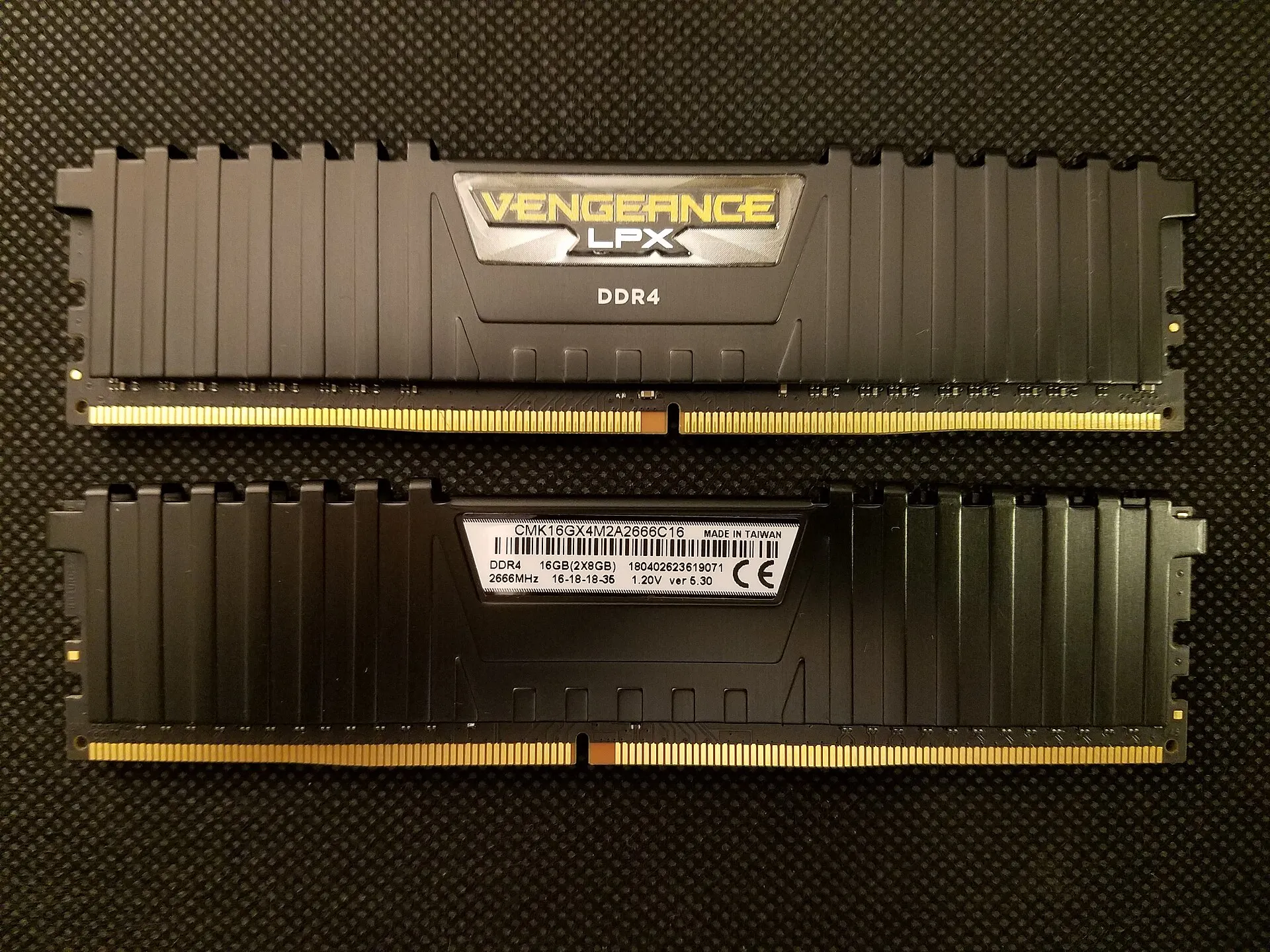
- Featured image: Corsair Vengeance LPX 2 × 8 GB DDR4 kit by Bretwa, CC BY-SA 4.0, via Wikimedia Commons